Fill a Valid Fedex Bill Of Lading Form
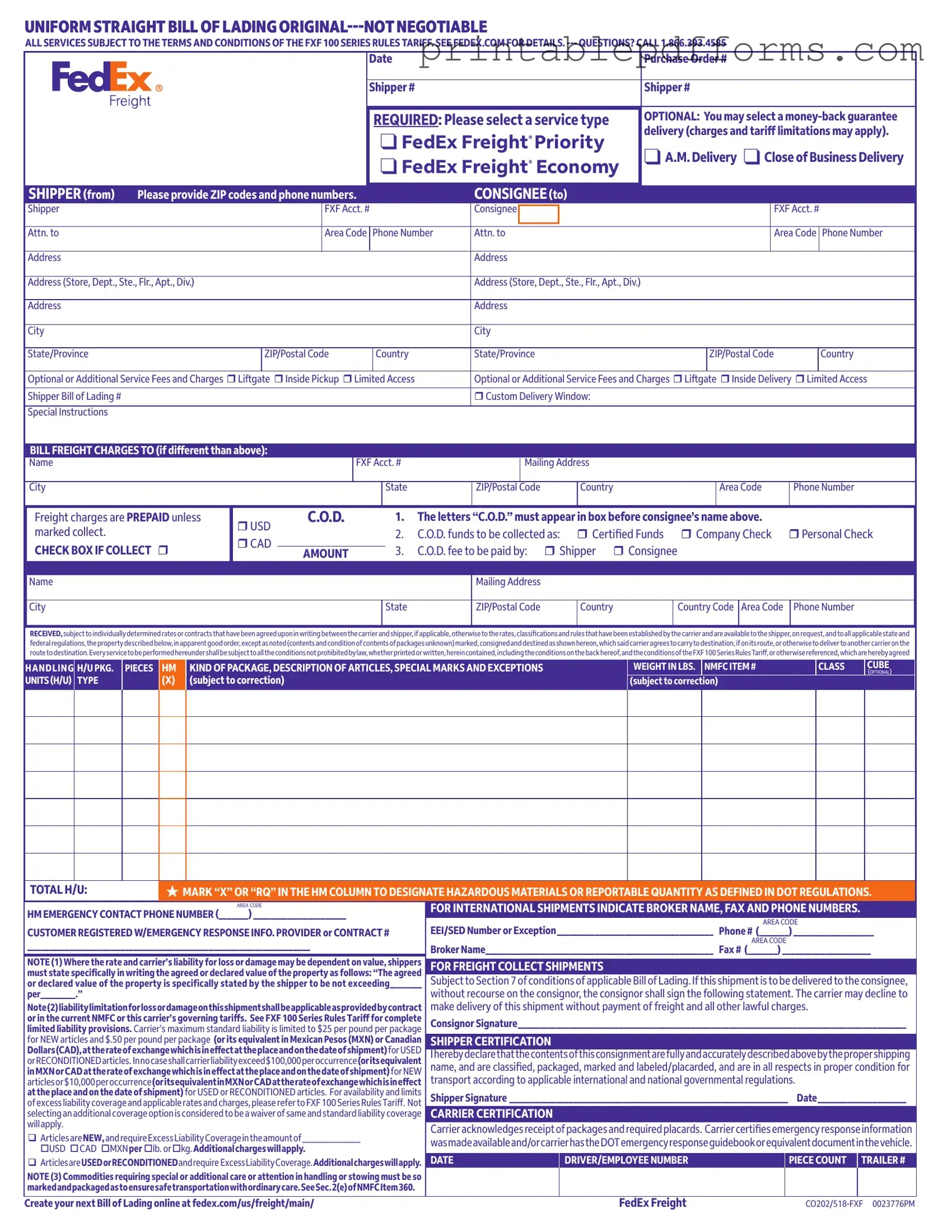
The FedEx Bill of Lading form serves as a crucial document in the shipping process, ensuring that both shippers and carriers have a clear understanding of their responsibilities and the details of the shipment. This form is designed to accompany freight shipments and is not negotiable, which means it outlines the terms under which the goods are transported. Essential information required on the form includes the date, purchase order number, and the identification of both the shipper and consignee, complete with contact details and addresses. Service options such as FedEx Freight Priority or Economy, along with additional services like liftgate or inside delivery, can be selected to meet specific shipping needs. Notably, the form also addresses freight charges, which are generally prepaid, but can be marked as collect if necessary. In cases where the shipment involves hazardous materials, specific markings and emergency contact information must be provided, ensuring compliance with safety regulations. Furthermore, the form stipulates liability limitations for loss or damage, emphasizing the importance of declaring the value of the shipment. By encapsulating these elements, the FedEx Bill of Lading form not only facilitates the logistical aspects of shipping but also safeguards the interests of all parties involved.
Additional PDF Templates
California State Disability - The form requires details about your medical condition and the impact on your ability to work.
For those seeking a reliable method to verify employment, our guide on how to properly use the Employment Verification form can be invaluable. This document plays a key role in confirming an individual’s employment details for various applications, from loan approvals to rental agreements. To discover more, visit our resources on the complete Employment Verification process.
Texas Odometer Statement - Completing the VTR-40 correctly is critical to avoid post-sale complications.
Childcare Invoice Template - This form can help ensure transparency between parents and care providers.
Similar forms
- Uniform Commercial Invoice: Like the FedEx Bill of Lading, a Uniform Commercial Invoice details the shipment of goods, including descriptions, quantities, and values. Both documents serve as proof of the transaction and are used for customs clearance.
Aaa International Driving Permit Application: This essential permit allows individuals to drive legally in foreign countries, serving as a translation of a U.S. driver's license and aiding communication with local authorities. To learn how to complete the application, refer to the Aaa International Driving Permit Application form for guidance.
- Air Waybill: An Air Waybill is similar in that it acts as a contract between the shipper and the carrier for air transport. It also includes shipping details and serves as a receipt, just like the FedEx Bill of Lading.
- Freight Bill: A Freight Bill outlines the charges for transporting goods, similar to how the FedEx Bill of Lading specifies freight charges. Both documents are essential for billing and payment processes.
- Shipping Manifest: A Shipping Manifest lists all items being shipped in a single shipment, much like the FedEx Bill of Lading. It provides a comprehensive view of the contents for both the shipper and the carrier.
- Delivery Receipt: A Delivery Receipt is issued upon delivery of goods, confirming receipt by the consignee. It parallels the FedEx Bill of Lading in that both documents track the movement of goods and confirm delivery.
- Packing List: A Packing List details the contents of a shipment, including weights and dimensions. While the FedEx Bill of Lading serves a broader purpose, both documents ensure that the shipper and consignee are aware of what is being transported.
- Export Declaration: An Export Declaration is required for international shipments and provides details on the goods being exported. Similar to the FedEx Bill of Lading, it ensures compliance with regulations and facilitates customs clearance.
Document Example
UNIFORM STRAIGHT BILL OF LADING
ALL SERVICES SUBJECT TO THE TERMS AND CONDITIONS OF THE FXF 100 SERIES RULES TARIFF. SEE FEDEX.COM FOR DETAILS.
|
|
|
|
|
|
|
|
|
|
|
|
|
|
|
|
|
|
|
|
|
|
|
|
|
|
|
|
|
|
|
|
|
Date |
|
|
|
|
|
|
|
|
Purchase Order # |
|
|
|
||||||
|
|
|
|
|
|
|
|
|
|
|
|
|
|
|
|
|
|
|
|
|
|
|
|||
|
|
|
|
|
|
|
Shipper # |
|
|
|
|
|
|
|
Shipper # |
|
|
|
|||||||
|
|
|
|
|
|
|
|
|
|
|
|
|
|
|
|
|
|||||||||
|
|
|
|
|
|
|
|
REQUIRED: Please select a service type |
OPTIONAL: You may select a |
||||||||||||||||
|
|
|
|
|
|
|
|
q |
FedEx Freight |
® |
Priority |
delivery (charges and tariff limitations may apply). |
|||||||||||||
|
|
|
|
|
|
|
|
q A.M. Delivery q Close of Business Delivery |
|||||||||||||||||
|
|
|
|
|
|
|
|
|
|
|
|
|
|
|
|||||||||||
|
|
|
|
|
|
|
|
q FedEx Freight® Economy |
|||||||||||||||||
|
|
|
|
|
|
|
|
|
|
|
|
|
|
|
|||||||||||
SHIPPER (from) |
Please provide ZIP codes and phone numbers. |
|
|
|
|
|
|
CONSIGNEE (to) |
|
|
|
|
|
|
|
|
|||||||||
Shipper |
|
|
|
|
FXF Acct. # |
|
|
Consignee |
|
|
|
|
|
|
|
|
|
FXF Acct. # |
|||||||
|
|
|
|
|
|
|
|
|
|
|
|
|
|
||||||||||||
|
|
|
|
|
|
|
|
|
|
|
|
|
|
|
|
|
|
|
|
|
|
|
|
|
|
Attn. to |
|
|
|
|
Area Code |
|
Phone Number |
Attn. to |
|
|
|
|
|
|
|
|
Area Code |
Phone Number |
|||||||
|
|
|
|
|
|
|
|
|
|
|
|
|
|
|
|
|
|
|
|
|
|
|
|
|
|
Address |
|
|
|
|
|
|
|
|
|
|
|
|
Address |
|
|
|
|
|
|
|
|
|
|
|
|
|
|
|
|
|
|
|
|
|
|
|
|
|
|
|
|
|
|
|
|
|
|
||||
Address (Store, Dept., Ste., Flr., Apt., Div.) |
|
|
|
|
|
|
|
|
|
|
|
Address (Store, Dept., Ste., Flr., Apt., Div.) |
|
|
|
|
|
|
|
||||||
|
|
|
|
|
|
|
|
|
|
|
|
|
|
|
|
|
|
|
|
|
|
|
|
|
|
Address |
|
|
|
|
|
|
|
|
|
|
|
|
Address |
|
|
|
|
|
|
|
|
|
|
|
|
|
|
|
|
|
|
|
|
|
|
|
|
|
|
|
|
|
|
|
|
|
|
|
|
|
|
City |
|
|
|
|
|
|
|
|
|
|
|
|
City |
|
|
|
|
|
|
|
|
|
|
|
|
|
|
|
|
|
|
|
|
|
|
|
|
|
|
|
|
|
|
|
|||||||
State/Province |
|
|
ZIP/Postal Code |
|
Country |
|
State/Province |
|
|
ZIP/Postal Code |
|
|
Country |
||||||||||||
|
|
|
|
|
|
|
|
|
|
|
|
|
|
||||||||||||
Optional or Additional Service Fees and Charges rLiftgate rInside Pickup rLimited Access |
|
Optional or Additional Service Fees and Charges rLiftgate rInside Delivery rLimited Access |
|||||||||||||||||||||||
Shipper Bill of Lading # |
|
|
|
|
|
|
|
|
|
|
|
|
rCustom Delivery Window: |
|
|
|
|
|
|
|
|||||
Special Instructions |
|
|
|
|
|
|
|
|
|
|
|
|
|
|
|
|
|
|
|
|
|
|
|
|
|
|
|
|
|
|
|
|
|
|
|
|
|
|
|
|
|
|
|
|
|
|
|
|
|
||
BILL FREIGHT CHARGES TO (if different than above): |
|
|
|
|
|
|
|
|
|
|
|
|
|
|
|
|
|
|
|
|
|
|
|||
Name |
|
|
|
|
|
FXF Acct. # |
|
|
|
Mailing Address |
|
|
|
|
|
|
|
||||||||
|
|
|
|
|
|
|
|
|
|
|
|
|
|
|
|
|
|
|
|
|
|
|
|||
City |
|
|
|
|
|
|
|
|
|
State |
|
ZIP/Postal Code |
Country |
|
|
Area Code |
|
Phone Number |
|||||||
|
|
|
|
|
|
|
|
|
|
|
|
|
|
|
|
|
|||||||||
Freight charges are PREPAID unless |
USD |
C.O.D. |
|
|
1. |
The letters |
“C.O.D.” must appear |
in box before consignee’s name above. |
|
|
|
||||||||||||||
marked collect. |
|
|
|
|
2. |
C.O.D. funds to be collected as: |
Certified Funds Company Check |
Personal Check |
|||||||||||||||||
|
CAD |
|
|
|
|||||||||||||||||||||
CHECK BOX IF COLLECT |
|
|
|
|
|
|
|
|
|
|
|
|
|
|
|
|
|
|
|
|
|
|
|||
AMOUNT |
3. |
C.O.D. fee to be paid by: Shipper Consignee |
|
|
|
||||||||||||||||||||
|
|
|
|
|
|||||||||||||||||||||
REMIT C.O.D. TO (if different than shipper above):
Name |
|
Mailing Address |
|
|
|
|
|
|
|
|
|
|
|
City |
State |
ZIP/Postal Code |
Country |
Country Code |
Area Code |
Phone Number |
|
|
|
|
|
|
|
RECEIVED, subject to individually determined rates or contracts that have been agreed upon in writing between the carrier and shipper, if applicable, otherwise to the rates, classifications and rules that have been established by the carrier and are available to the shipper, on request, and to all applicable state and federal regulations, the property described below, in apparent good order, except as noted (contents and condition of contents of packages unknown) marked, consigned and destined as shown hereon, which said carrier agrees to carry to destination, if on its route, or otherwise to deliver to another carrier on the route to destination. Every service to be performed hereunder shall be subject to all the conditions not prohibited by law, whether printed or written, herein contained, including the conditions on the back hereof, and the conditions of the FXF 100 Series Rules Tariff, or otherwise referenced, which are hereby agreed
|
|
|
|
|
|
|
|
HANDLING H/U PKG. |
PIECES |
HM |
KIND OF PACKAGE, DESCRIPTION OF ARTICLES, SPECIAL MARKS AND EXCEPTIONS |
WEIGHT IN LBS. |
NMFC ITEM # |
CLASS |
CUBE |
(optional) |
|||||||
UNITS (H/U) TYPE |
|
(X) |
(subject to correction) |
(subject to correction) |
|
|
|
|
TOTAL H/U: |
|
H MARK “X” OR “RQ” IN THE HM COLUMN TO DESIGNATE HAZARDOUS MATERIALS OR REPORTABLE QUANTITY AS DEFINED IN DOT REGULATIONS. |
|
||||||
|
|
|
|
FOR INTERNATIONAL SHIPMENTS INDICATE BROKER NAME, FAX AND PHONE NUMBERS. |
|
|||||
|
|
|
area code |
|
|
|
|
|
|
|
|
HM EMERGENCY CONTACT PHONE NUMBER (_______) ______________________ |
|
|
|
|
|
|
|||
EEI/SED Number or Exception______________________________________ |
AREA CODE |
|||||||||
|
CUSTOMER REGISTERED W/EMERGENCY RESPONSE INFO. PROVIDER or CONTRACT # |
Phone # (_______) ___________________ |
||||||||
___________________________________________________________________ |
Broker Name______________________________________________________ |
AREA CODE |
||||||||
Fax # (_______) _____________________ |
||||||||||
|
NOTE (1) Where the rate and carrier’s liability for loss or damage may be dependent on value, shippers |
|
|
|
|
|
|
|||
FOR FREIGHT COLLECT SHIPMENTS |
|
|
|
|
||||||
|
must state specifically in writing the agreed or declared value of the property as follows: “The agreed |
|
|
|
|
|||||
Subject to Section 7 of conditions of applicable Bill of Lading. If this shipment is to be delivered to the consignee, |
||||||||||
|
or declared value of the property is specifically stated by the shipper to be not exceeding________ |
|||||||||
|
per_________.” |
|
|
without recourse on the consignor, the consignor shall sign the following statement. The carrier may decline to |
||||||
|
Note(2)liabilitylimitationforlossordamageonthisshipmentshallbeapplicableasprovidedbycontract |
make delivery of this shipment without payment of freight and all other lawful charges. |
||||||||
|
or in the current NMFC or this carrier’s governing tariffs. See FXF 100 Series Rules Tariff for complete |
Consignor Signature____________________________________________________________________________________________ |
||||||||
|
limited liability provisions. Carrier’s maximum standard liability is limited to $25 per pound per package |
|||||||||
|
for NEW articles and $.50 per pound per package (or its equivalent in Mexican Pesos (MXN) or Canadian |
SHIPPER CERTIFICATION |
|
|
|
|
|
|||
|
Dollars(CAD),attherateofexchangewhichisineffectattheplaceandonthedateofshipment)for USED |
Iherebydeclarethatthecontentsofthisconsignmentarefullyandaccuratelydescribedabovebythepropershipping |
||||||||
|
orRECONDITIONEDarticles. Innocaseshallcarrierliabilityexceed$100,000peroccurrence(oritsequivalent |
name, and are classified, packaged, marked and labeled/placarded, and are in all respects in proper condition for |
||||||||
|
inMXNorCADattherateofexchangewhichisineffectattheplaceandonthedateofshipment) for NEW |
|||||||||
|
articlesor$10,000peroccurrence(oritsequivalentinMXNorCADattherateofexchangewhichisineffect |
transport according to applicable international and national governmental regulations. |
||||||||
|
at the place and on the date of shipment) for USED or RECONDITIONED articles. For availability and limits |
Shipper Signature___________________________________________________________________ Date_____________________ |
||||||||
|
of excess liability coverage and applicable rates and charges, please refer to FXF 100 Series Rules Tariff. Not |
|||||||||
|
selecting an additional coverage option is considered to be a waiver of same and standard liability coverage |
CARRIER CERTIFICATION |
|
|
|
|
|
|||
|
willapply. |
|
|
Carrier acknowledges receipt of packages and required placards. Carrier certifies emergency response information |
||||||
|
ArticlesareNEW,andrequireExcessLiabilityCoverageintheamountof_______________ |
wasmadeavailableand/orcarrierhastheDOTemergencyresponseguidebookorequivalentdocumentinthevehicle. |
||||||||
|
oUSD oCAD oMXNper olb. orokg.Additionalchargeswillapply. |
|||||||||
|
ArticlesareUSEDorRECONDITIONEDandrequire ExcessLiabilityCoverage.Additionalchargeswillapply. |
DATE |
DRIVER/EMPLOYEE NUMBER |
|
PIECE COUNT |
TRAILER # |
||||
|
NOTE (3) Commodities requiring special or additional care or attention in handling or stowing must be so |
|
|
|
|
|
|
|||
|
markedandpackagedastoensuresafetransportationwithordinarycare.SeeSec.2(e)ofNMFCItem360. |
|
|
|
|
|
|
|||
Create your next Bill of Lading online at fedex.com/us/freight/main/ |
|
FedEx Freight |
|
|||||||
Form Specs
| Fact Name | Details |
|---|---|
| Form Type | Uniform Straight Bill of Lading |
| Negotiability | This bill of lading is original and not negotiable. |
| Service Terms | All services are subject to the terms and conditions of the FXF 100 Series Rules Tariff. |
| Contact Information | For questions, call 1.866.393.4585. |
| Freight Charges | Freight charges are prepaid unless marked collect. |
| Hazardous Materials | Mark “X” or “RQ” in the HM column to designate hazardous materials. |
| Liability Limit | Carrier's liability is limited to $25 per pound for new articles. |
| Governing Law | State-specific laws apply, and federal regulations must be followed. |
Crucial Questions on This Form
What is a FedEx Bill of Lading?
A FedEx Bill of Lading is a document that serves as a receipt for the goods being shipped. It outlines the terms and conditions of the shipment, including the services requested, addresses, and any special instructions. This document is essential for both the shipper and the carrier, as it provides proof of the agreement between the two parties regarding the transportation of goods.
How do I fill out the FedEx Bill of Lading?
To complete the FedEx Bill of Lading, follow these steps:
- Start with the date and purchase order number.
- Fill in the shipper's and consignee's information, including names, addresses, and phone numbers.
- Select the service type you require, such as FedEx Freight Priority or Economy.
- Include any optional services, like liftgate or inside delivery, if needed.
- Indicate whether freight charges are prepaid or if the shipment is C.O.D. (Collect on Delivery).
- List the details of the shipment, including the type of package, weight, and any special handling requirements.
Make sure to review the completed form for accuracy before submitting it.
What should I do if I need to change information after submitting the Bill of Lading?
If you need to make changes after submitting the Bill of Lading, contact FedEx customer service as soon as possible. Provide them with your shipment details and the specific changes you need to make. Depending on the status of your shipment, they may be able to assist you in updating the information.
Are there any fees associated with using the FedEx Bill of Lading?
Yes, there may be fees associated with using the FedEx Bill of Lading. These can include charges for optional services such as liftgate delivery or inside pickup. Additionally, if you choose a money-back guarantee or if your shipment requires special handling, those fees will apply as well. Always check the FedEx website or contact customer service for the most accurate fee information.
What happens if my shipment is lost or damaged?
If your shipment is lost or damaged, you should report it to FedEx as soon as possible. You will need to provide your Bill of Lading number and details about the shipment. The carrier's liability for loss or damage is limited, so it’s important to understand the coverage options you selected when shipping. For claims, you may need to fill out specific forms and provide documentation to support your case.
Can I track my shipment using the Bill of Lading?
Yes, you can track your shipment using the Bill of Lading number. Simply visit the FedEx website and enter the Bill of Lading number in the tracking section. This will provide you with real-time updates on the status and location of your shipment, allowing you to stay informed throughout the delivery process.
Documents used along the form
The FedEx Bill of Lading is an essential document for shipping freight, but it often works in tandem with other forms to ensure smooth logistics and compliance. Here’s a list of some commonly used documents that complement the Bill of Lading, each serving a unique purpose in the shipping process.
- Freight Invoice: This document details the charges for the transportation of goods. It includes information about the shipment, such as weight, dimensions, and any additional services provided. The invoice is crucial for billing and record-keeping.
- Shipping Label: A shipping label contains vital information, including the sender's and recipient's addresses, tracking number, and service type. It ensures that packages are correctly routed and delivered to the right location.
- Delivery Receipt: Upon delivery, the recipient signs this document to confirm they have received the shipment in good condition. It serves as proof of delivery and can be important for resolving disputes regarding lost or damaged goods.
- Customs Declaration: For international shipments, a customs declaration form is required to inform customs authorities about the contents of the package. This document helps in assessing duties and ensuring compliance with import/export regulations.
- ADP Pay Stub: This document provides employees with a detailed breakdown of their earnings, deductions, and other important information related to their compensation. For more information, visit Top Document Templates.
- Insurance Certificate: This document provides proof of insurance coverage for the shipment. It outlines the terms of coverage and is essential for protecting the shipper against potential loss or damage during transit.
- Hazardous Materials (HAZMAT) Declaration: If the shipment contains hazardous materials, this declaration is necessary. It outlines the nature of the materials and ensures compliance with safety regulations during transport.
- Export License: Required for certain goods being shipped internationally, an export license grants permission from the government to export specific items. It ensures that all legal requirements are met before the shipment leaves the country.
Using these documents alongside the FedEx Bill of Lading can streamline the shipping process and help avoid potential issues. Proper documentation not only facilitates smoother transactions but also ensures compliance with various regulations, making it an indispensable part of logistics management.
Misconceptions
Here are five misconceptions about the FedEx Bill of Lading form:
- Misconception 1: The Bill of Lading is not important.
- Misconception 2: You can skip filling out all sections.
- Misconception 3: The Bill of Lading guarantees delivery.
- Misconception 4: You don’t need to keep a copy.
- Misconception 5: All shipments have the same liability coverage.
Many people believe that the Bill of Lading is just a formality. In reality, it serves as a legal document that outlines the terms of the shipment and provides proof of the contract between the shipper and the carrier.
Some think that they can leave sections blank if they are not relevant. However, missing information can lead to delays or issues with the shipment. It is best to provide as much detail as possible.
People often assume that having a Bill of Lading guarantees their shipment will arrive on time. While it outlines the agreement, delays can still happen due to various factors beyond the carrier's control.
Some individuals believe that once the shipment is sent, they don’t need to keep a copy of the Bill of Lading. However, retaining a copy is important for tracking and resolving any potential issues.
Many assume that liability coverage is uniform across all shipments. In fact, coverage can vary based on the type of goods and the options selected on the Bill of Lading. It's important to understand the specifics of your coverage.